

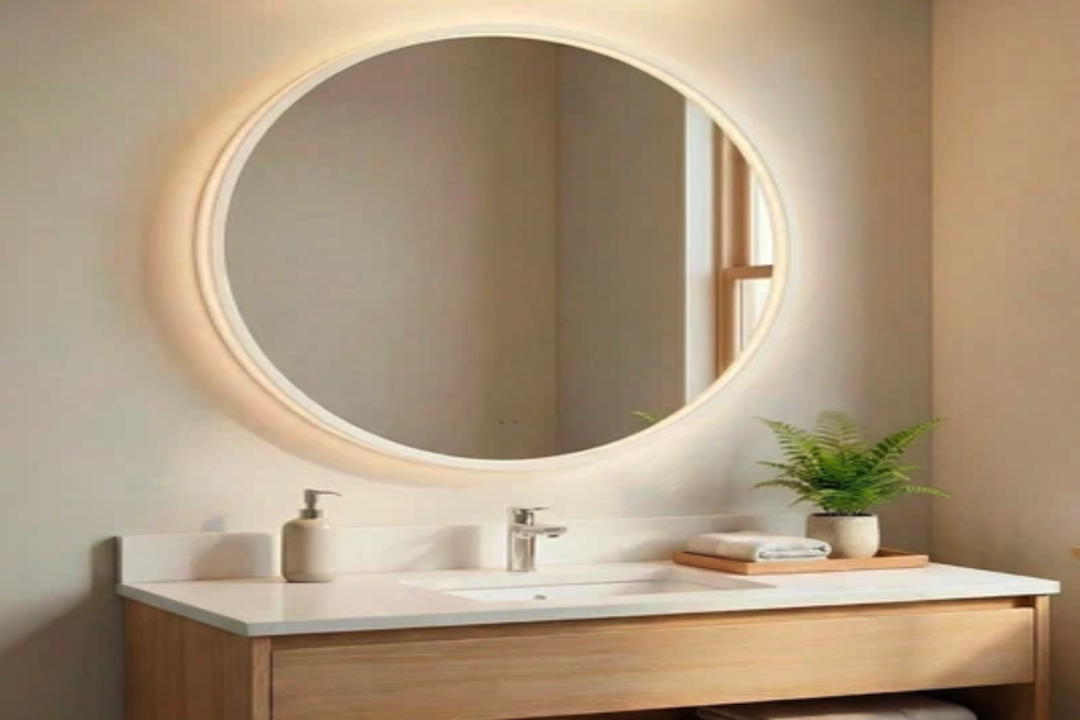
Okay, so you’re thinking about getting one of those fancy motion-sensor vanity lights for your bathroom mirror? Smart move! Let’s break down what these things are all about, why they’re actually pretty neat, and what you should be looking for.
Qu’est-ce qu’une Lumière de Vanité avec Capteur de Mouvement ?
Basically, it’s a light fixture designed to go around or above your bathroom mirror that turns on automatically when it senses you’re nearby and turns off when you leave. Think of it as a little bit of everyday magic that makes your bathroom routine a little smoother. No more fumbling for Um4u light switches in the dark when you’re half asleep or have your hands full. It’s about convenience, a touch of modern tech, and honestly, it just feels good to have things work so seamlessly.
Pourquoi Ajouter une Lumière de Vanité à Détection de Mouvement ?
The biggest perk? Pure, unadulterated convenience. We’ve all been there: stumbling into the bathroom in the early morning, eyes half-closed, trying to locate the light switch. Or maybe you’ve got soapy hands and need to adjust the lighting. With a motion sensor, that’s a problem of the past. It’s about making your life a tiny bit easier, and sometimes, those little conveniences are the most impactful.
Un Confort Instantané
Imagine this: you walk into your bathroom at night, and poof, the light comes on, just enough to see without being blinding. You’re getting ready in the morning, your hands are covered in face wash, and the light gracefully illuminates your task. It’s that simple, that intuitive. It removes a minor but persistent point of friction from your daily routine.
Une Touche d’Élégance Moderne
Beyond the practicality, these lights can really elevate the look of your bathroom. They add a sleek, contemporary feel. It’s a subtle upgrade that speaks to a well-thought-out space. It’s not about being flashy, but about adding a touch of sophistication that feels both functional and aesthetically pleasing.
Des Économies d’Énergie (Potentielles)
While the primary draw is convenience, there’s a secondary benefit: energy savings. Lights that turn on only when needed and turn off automatically are inherently more efficient. You’re not accidentally leaving the bathroom lights on all day because you forgot. Over time, this can translate to a small but welcome reduction in your electricity bill.
Sécurité Accrue dans l’Obscurité
For those late-night trips to the bathroom, the automatic illumination can also be a safety feature. It reduces the risk of tripping or bumping into things in a dimly lit or completely dark room. This is especially important if you have children or elderly individuals in your home.
Les Caractéristiques Essentielles à Rechercher
So, you’re sold on the idea, but what should you actually look for when buying one of these? It’s not just about picking the prettiest one. There are a few key features that make a big difference in how well it performs and how much you’ll enjoy it.
Le Type de Capteur
This is the heart of the « motion sensor » part. Different types exist, each with its own pros and cons. Understanding these will help you choose one that fits your bathroom and your habits.
Capteurs Infrarouges Passifs (PIR)
These are the most common. They detect changes in infrared radiation, which is basically body heat.
- Avantages : Generally reliable, good at detecting movement within their range. They’re energy-efficient as they don’t emit anything.
- Inconvénients : Can sometimes be triggered by sudden temperature changes (like a blast of hot air from a hair dryer) or may have trouble detecting very slow movements if the person is stationary for too long. Their effectiveness can also be slightly reduced by thick clothing.
Capteurs à Ultrasons
These emit ultrasonic waves and listen for the echoes. When something moves and disrupts these echoes, the sensor triggers.
- Avantages : Can detect movement through thin obstacles (like a shower curtain) and are less prone to false triggers from heat fluctuations. They can also detect slower movements more reliably than PIR sensors.
- Inconvénients : Can sometimes be sensitive to high-pitched noises, and the technology is generally a bit more complex, potentially leading to higher costs.
Capteurs Radar (ou à Micro-ondes)
Similar to ultrasonic, these use radio waves. They can penetrate materials like plastic or drywall.
- Avantages : Very sensitive, can detect even subtle movements, and can work through some materials. They are often used in more high-end systems for greater accuracy and range.
- Inconvénients : Can be too sensitive, leading to more frequent false triggers if not properly calibrated. They also use a bit more power than PIR sensors.
Capteurs Combinés
Some advanced models combine two or more types of sensors for enhanced accuracy and reliability. For example, a PIR sensor might be used for initial detection, and an ultrasonic sensor could confirm the movement.
La Portée et l’Angle de Détection
This is crucial. You want a sensor that covers the area you need it to.
- Portée : How far away can the sensor detect motion? For a typical bathroom vanity, a few meters is usually sufficient. You don’t want it to trigger when someone is just walking down the hallway outside the bathroom door, nor do you want it to miss you when you step in front of the mirror.
- Angle : What’s the field of view? A wider angle is generally better for a vanity light, ensuring it picks up movement as you approach from different angles. Think about how you typically enter and move around your bathroom.
La Sensibilité Réglable
This is a game-changer. The ability to adjust how sensitive the sensor is to movement allows you to fine-tune its performance.
- Éviter les Faux Déclenchements : If your bathroom is near a busy area or prone to drafts, you might need to lower the sensitivity.
- Assurer une Activation Fiable : Conversely, if you find it’s not always turning on, you can increase the sensitivity. This feature makes the light much more practical and less annoying.
Le Délai d’Extinction
How long does the light stay on after the motion stops? This is another important setting.
- Trop Court : If it’s too short, the light will keep turning off while you’re still there, which is frustrating.
- Trop Long : If it’s too long, you’re defeating the purpose of energy saving and potentially leaving the light on unnecessarily.
- Réglable, c’est Mieux : Look for lights where you can set this duration. This allows you to customize it to your specific needs, whether you’re doing a quick touch-up or a more involved skincare routine.
Le Type d’Éclairage (Couleur et Intensité)
Beyond the motion sensor, the light itself matters.
- Température de Couleur : This refers to the « warmth » or « coolness » of the light.
- Blanc Chaud (environ 2700K-3000K) : Creates a cozy, inviting atmosphere, similar to traditional incandescent bulbs. Good for a relaxing ambiance.
- Blanc Neutre (environ 3500K-4000K) : A good balance, offering clear, natural-looking light. Excellent for grooming tasks.
- Blanc Froid (environ 5000K-6500K) : Mimics daylight, providing very bright, crisp illumination. Can be great for detailed tasks but might feel harsh in some settings.
- Intensité (Luminosité) : Measured in lumens. You want enough brightness for your tasks but not so much that it’s blinding.
- Dimmable : Some lights allow you to adjust the brightness, which adds another layer of customization.
Types d’Installations et de Designs
These lights aren’t one-size-fits-all. They come in various forms and can be integrated into your bathroom in different ways.
L’Éclairage Intégré au Miroir
This is often the most seamless and modern look. The lights are built directly into the mirror itself.
- Avantages : Very clean aesthetic, no visible fixtures or wires. The light distribution is often designed to be very even.
- Inconvénients : Can be more expensive, and if the LED strip or sensor fails, you might have to replace the entire mirror. Installation can also be more complex, often requiring professional help for wiring.
L’Éclairage Autour du Miroir
These are separate fixtures that you install around the perimeter of the mirror.
- Bandes LED Adhésives : These are flexible strips with an adhesive backing that you stick directly onto the back of the mirror or the wall around it. They often come with a separate control box for the sensor and power.
- Avantages : Relatively easy to install (DIY-friendly), affordable, and can be cut to size. You can choose the placement for the best light diffusion.
- Inconvénients : The adhesive might fail over time, and the look might not be as integrated as built-in options. Wiring can sometimes be a bit visible.
- Appliques Murales Spécifiques : These are dedicated light fixtures designed to be mounted on the wall on either side of the mirror, or above it. Some are specifically designed with motion sensors.
- Avantages : Can offer more powerful lighting, a more traditional and robust look.
- Inconvénients : Requires more involved installation (drilling, wiring), and you need to ensure they are positioned correctly to illuminate the mirror effectively without casting shadows.
Les Luminaires sur Pied ou à Clipser
Less common for true vanity lighting, but some smaller portable options exist.
- Avantages : Extremely versatile, no installation required, can be moved around.
- Inconvénients : May not provide sufficient or evenly distributed light for a vanity area. The sensor might also be less effective if it’s not positioned correctly. Power source is often battery-operated, requiring frequent changes.
Installation et Configuration : Ce Qu’il Faut Savoir
Let’s talk brass tacks: how do you get this thing up and running? Installation can range from super simple to a bit more involved, depending on the type of light you choose.
Les Options DIY (Do It Yourself)
Many modern vanity lights, especially LED strips, are designed with DIY installation in mind.
- Nettoyage de la Surface : Before sticking anything, make sure the area where you’ll be applying adhesive is clean and dry. This is crucial for long-term adhesion.
- Connexion Électrique : Some might plug into an existing outlet, while others might require hardwiring. If you’re not comfortable with electrical work, it’s always best to consult an electrician. Many plug-in options come with the necessary adapters.
- Placement du Capteur : Think about where you’ll be when the light should turn on. You don’t want it to be blocked by anything. For strips, the control box with the sensor is often hidden behind the mirror or along the frame.
Quand Faire Appel à un Professionnel ?
For built-in mirror lights or if you’re unsure about electrical connections, hiring a pro is the way to go.
- Câblage : If the fixture requires direct wiring into your home’s electrical system, a qualified electrician is essential for safety and compliance.
- Intégration Parfaite : For a truly integrated look with mirror lights, professional installation ensures a clean finish and proper functioning.
- Assurance Qualité : An electrician can also advise on the best placement and ensure the installation meets safety codes.
Paramétrage Initial
Once installed, you’ll likely need to set up the sensor.
- Testez la Portée : Walk in and out of the detection zone to ensure it’s triggering reliably.
- Ajustez la Sensibilité et le Délai : Play with the settings until you find what works best for your bathroom and your routine. This might take a little trial and error.
Questions Fréquentes et Conseils Pratiques
You’ve got questions, we’ve got answers. Here are some common things people wonder about, and a few tips to make your life easier.
Mon Capteur s’Activerait-il Trop Souvent ?
This is a common concern. If you have a lot of activity in or near the bathroom, or if the sensor is too sensitive, you might get false triggers.
- Solution : Adjust the sensitivity down. Also, consider the placement of the sensor. If it’s facing a window with direct sunlight, strong temperature changes, or a vent, it might be confused. Sometimes, a slight repositioning can make a big difference.
Et S’il Ne S’Allume Pas Quand J’en Ai Besoin ?
The opposite problem! It’s frustrating when you’re standing there, and nothing happens.
- Solution : Increase the sensitivity. Ensure you’re entering the detection zone within the sensor’s range and angle. Check that the light is properly powered and that the sensor itself isn’t obstructed.
Quelle Est la Durée de Vie des LED ?
LEDs are known for their longevity, but it’s still a valid question.
- Longévité : Most LED strips in vanity lights are rated for tens of thousands of hours. This means they should last for many years under normal use.
- Remplacement : If an LED strip does fail, especially with adhesive types, it’s usually possible to replace just the strip. For integrated mirror lights, it might be a more complex repair or replacement of the entire unit.
Comment Nettoyer Ces Luminaires ?
Keeping your bathroom clean is important, and that includes your new light fixture.
- Doux et Sec : For most fixtures, a soft, dry microfiber cloth is sufficient for dusting.
- Légèrement Humide : For stubborn smudges, slightly dampen the cloth with water. Avoid harsh chemicals or abrasive cleaners, as they can damage the finish or the sensor.
- Attention aux Capteurs : Be gentle around the sensor itself. You don’t want to scratch or damage it.
Puis-Je M’En Servir Dans une Salle de Bain Très Humide ?
Humidity can be a concern for any electrical device.
- Indice IP : Look for fixtures with a good Ingress Protection (IP) rating. An IP rating of IP44 or higher is generally recommended for bathrooms, indicating protection against splashes of water.
- Installation : Ensure any wiring is properly sealed and protected from moisture.
Choosing a motion-sensor vanity light is a practical upgrade that can genuinely improve your daily bathroom experience. It’s about that seamless blend of technology and everyday life, making simple tasks just a little bit more effortless. By understanding the different features and installation options, you can find one that perfectly suits your needs and your bathroom’s style.